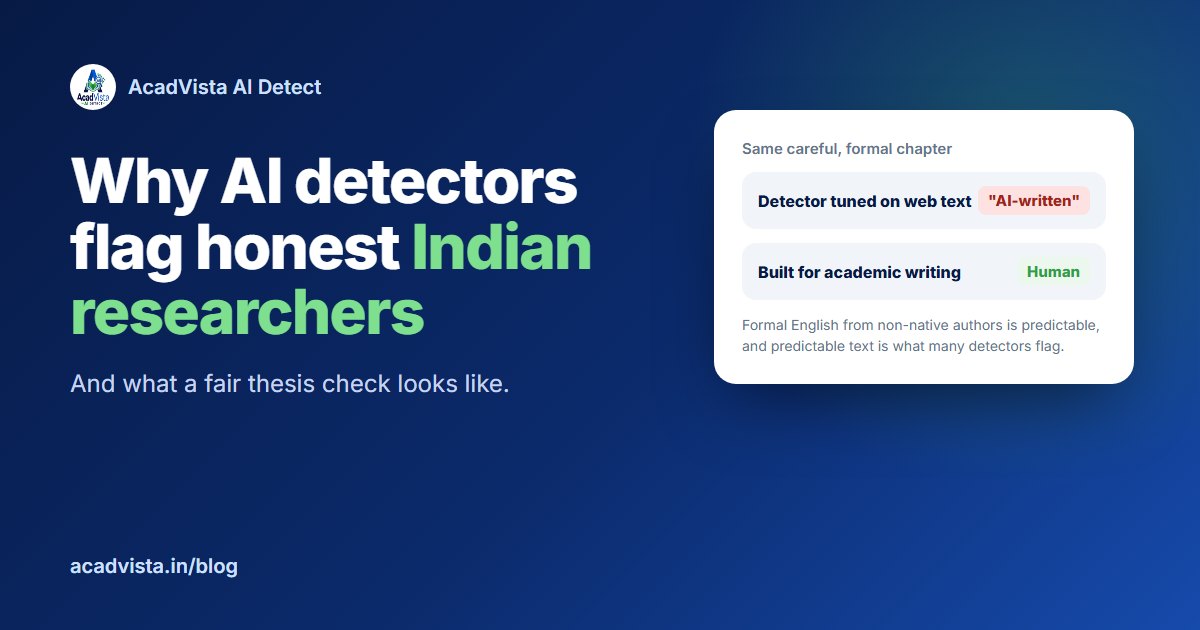
Picture an M.Pharm scholar who runs her literature review through a free online AI checker the night before submission. It comes back at 74% AI. She wrote every word herself, in the careful, formal English her guide asked for. Now she has to decide whether to rewrite a chapter that a machine never touched.
This happens more often than it should, and there is published research that explains why.
What the research found
In 2023, researchers at Stanford University tested seven widely used AI detectors on essays that non-native English speakers wrote for the TOEFL exam. The detectors labelled more than half of these human-written essays as AI-generated, an average false-positive rate of 61.3%. At least one detector flagged 97.8% of them. On essays by native English-speaking students, the same detectors were close to perfect (Liang et al., Patterns, 2023).
The reason lies in how many detectors work. They measure how predictable a text is to a language model. Writing that uses a smaller range of words and sentence patterns is more predictable, so it looks machine-like to the detector. The study saw the same pattern in research papers: papers whose first authors came from non-English-speaking countries were more predictable to the model.
The researchers also showed the opposite problem. When they asked ChatGPT to rewrite its own text in more literary language, detection of that text fell to almost zero. So the risk runs both ways: honest writers get flagged, and AI text slips through after one extra prompt.
Why this matters for Indian theses
Most theses, dissertations and research papers in India are written in a second language, in a formal register that rewards standard phrasing. Methods sections reuse accepted wording. Pharmacopoeial monographs and regulatory guidelines are quoted as they are. Reference lists follow a fixed style. A detector tuned on blog posts and school essays reads all of this as suspicious.
The tools universities use to check theses are licensed to institutions, so most scholars cannot check their own draft before they submit it. Often the first score a student sees is the one already on record.
What AcadVista AI Detect does differently
We built AcadVista AI Detect for academic writing from the start, and we treat a false accusation as the most serious mistake a detector can make.
- Fair to non-native English. Fewer than 1% of genuine academic passages are flagged, whether or not English is the author's first language.
- Made for what a thesis contains. Reference lists and standard quoted texts, such as pharmacopoeial monographs and regulatory guidelines, are not counted against you.
- Built for current AI text. It detects text from ChatGPT and Gemini, including text that was asked to "sound human", and AI text that was reworded by another AI tool.
- Shows you where, not just how much. You get an overall percentage and every flagged passage highlighted in your document, with a PDF report to share with your guide.
- Open to you, before submission. Anyone with an email address can check a document. Your first document of up to 10,000 words is free, then it is ₹50 per document of up to 20,000 words.
- Private. Your file is deleted as soon as the check ends. Documents are never added to a repository or shared.
How it compares
Here is how AcadVista AI Detect compares with the two kinds of tools most scholars meet: free online AI checkers, and the tools universities license. Details vary from one tool to another, so check the one you use.
Who can use it. Free online checkers: anyone. University tools: usually only through your institution. AcadVista AI Detect: anyone, before submission.
What it is built for. Free online checkers: general web text and essays. AcadVista AI Detect: theses, dissertations and research papers.
Non-native English. Widely used detectors: published research has found high false-positive rates on non-native writing. AcadVista AI Detect: fewer than 1% of genuine academic passages flagged.
References and quoted standards. Free online checkers: usually no special handling. AcadVista AI Detect: not counted against you.
Your document afterwards. Other tools: depends on the tool and its settings, so read the privacy policy. AcadVista AI Detect: deleted as soon as the check ends.
Price. Free online checkers: free with word limits, or a subscription, often in dollars. University tools: paid by the institution. AcadVista AI Detect: first document free, then ₹50 per document, paid in rupees with UPI.
What it cannot do
No detector is proof. AcadVista AI Detect gives a statistical judgement of how a text reads, and a high score should start a conversation, not end one. Text passed through dedicated humanizer services or heavily edited by hand can be missed, and we say so openly. Scores from different tools are not identical, and this is an AI check, not a plagiarism (similarity) check. Our reliability page sets out the limits in full.
How to use it before you submit
- Write your chapter from your own sources, in your own words.
- Check it with AcadVista AI Detect and read every highlighted passage.
- Where a passage reads as machine-written, rework it in your own voice, and disclose any AI help the way your university asks.
- Download the PDF report and share it with your guide.
If you want to learn to write with AI honestly, our course Using Claude for Research & Thesis Writing at Acadvista Academy shows the whole method, from verified references to an AI-use statement.
For departments, IQAC cells and research committees, we offer bulk credits with invoices. Colleges on AcadVista ERP can write to us at info@acadvista.in.
Check your first document free at aidetect.acadvista.in.
Reference
Liang W, Yuksekgonul M, Mao Y, Wu E, Zou J. GPT detectors are biased against non-native English writers. Patterns. 2023;4(7):100779. doi:10.1016/j.patter.2023.100779